 +61 414 773 988
AI & Leadership: Thinking With, Not Replacing, What Makes Us Human
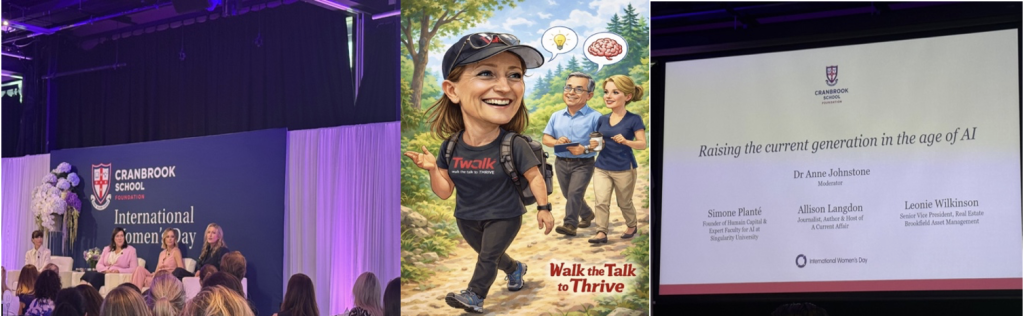
This month I’ve spent a bit of time thinking about AI and how it is impacting businesses day to day. There have been several companies laying people off as their jobs get automated, graduate needs and programs are changing to meet business needs and so on and so forth. At the International Women’s Day lunch I attended, a brilliant panel discussed “Raising the current generation in the age of AI” and it provided much food for thought on the change that it is here and what the next 10 years will look like.
Artificial Intelligence is no longer a future concept—it’s here, embedded in how we work, decide, and lead. For many leaders, the question is no longer “What is AI?” but rather “How do I use it effectively without losing what makes my leadership impactful?”
What is AI, really?
At its core, AI refers to systems that can analyse data, recognise patterns, generate insights, and even create content, often faster and at greater scale than humans. But AI is not intelligence in the human sense. It doesn’t hold values, intent, or accountability. It doesn’t inspire, empathise, or build trust.
It augments thinking – it doesn’t replace it.
The real opportunity lies in learning to think with AI, not defer to it.
Using AI effectively in your business
Leaders who get the most from AI use it as a thinking partner across three key areas:
Insight generation
AI can rapidly synthesise large volumes of information – market trends, customer feedback, internal data – and surface patterns you may not see alone. This enables more informed, timely decision-making.
Productivity and automation
Routine, repeatable tasks – reporting, drafting communications, data analysis – can be streamlined. This frees up time for higher-value leadership work: strategy, relationships, and innovation.
Scenario exploration
AI can help you test ideas, model potential outcomes, and challenge your thinking. It becomes a sounding board, one that expands your perspective rather than replaces your judgement.
The key is intentional use. AI should sharpen your thinking, not dull it.
The impact on you as a leader
AI is reshaping leadership in subtle but powerful ways.
The most effective leaders will not be those who know the most, but those who:
- Ask the best questions
- Interpret insights with discernment
- Make decisions grounded in values, not just data
AI can provide answers. Leadership still requires judgement.
It also raises a critical shift: Your role moves from being the source of knowledge to the curator of meaning.
Where AI falls short: the human edge
While AI excels in speed, scale, and logic, it struggles in areas that define strong organisations:
- Culture – AI can analyse engagement, but it cannot create belonging
- Trust – It cannot build relationships or demonstrate integrity over time
- Team dynamics – It cannot read the room, sense tension, or foster connection
- Accountability – It does not own outcomes, leaders do
This is where leadership becomes even more important.
The real question: What impact has AI had on your business?
Many organisations are already seeing:
- Faster decision cycles
- Improved efficiency
- More data-informed strategies
But there’s also a risk: Over-reliance on AI can lead to disconnection – from people, purpose, and the nuances that drive real performance.
The most successful businesses are those that integrate AI without losing their human centre.
Leading effectively in an AI-enabled world
To lead well alongside AI, consider these practices:
- Stay actively engaged in thinking
Don’t outsource critical thinking. Use AI to challenge and expand your perspective, but always apply your own judgement. - Be transparent with your team
Share how and why you’re using AI. This builds trust and reduces fear or uncertainty. - Invest in human capability
As AI takes over tasks, double down on developing skills like communication, emotional intelligence, and collaboration. - Model balance
Demonstrate that efficiency doesn’t come at the expense of connection. Show your team that people still come first.
Building culture and trust in an AI-driven organisation
Culture is shaped by what leaders do consistently – not what tools they use.
To maintain strong culture and trust:
- Prioritise human connection: Regular check-ins, real conversations, and presence matter more than ever
- Create psychological safety: Encourage questions, curiosity, and even scepticism about AI
- Align AI use with values: Ensure decisions supported by AI still reflect your organisation’s principles
- Hold accountability: AI can inform decisions, but leaders must own them
Trust is built when people feel seen, heard, and valued.
Final thoughts
AI is a powerful tool, but it is just that: a tool.
The leaders who will thrive are those who can:
- Leverage AI for insight and efficiency
- Think critically alongside it
- And lead with clarity, empathy, and integrity
Because while AI can process information, only you can create meaning, inspire people, and shape the future of your organisation.
The future of leadership isn’t AI-led.
It’s human-led, with AI as a powerful partner.
I’d love to know what you think…what impact has AI had on your business? How do you use AI while still leading effectively? How do you ensure you build good culture and trust in your organisation and lead your teams effectively? I’d love to know your thoughts…send me a DM and let’s Twalk!


 © 2019